


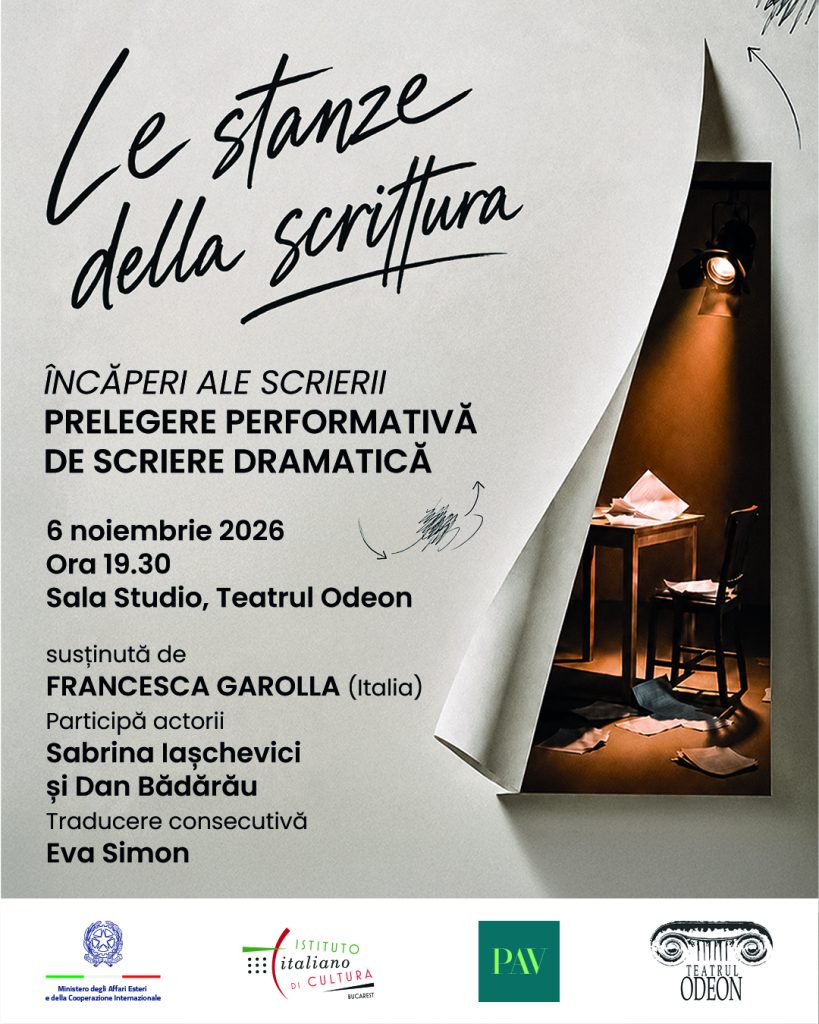
How does a play come into being? What intuitions, doubts and choices shape its journey? “Le stanze della scrittura” (The Writing Rooms) is a series of performative lectures that invites audiences into the creative workshop of contemporary Italian playwriting.
Promoted by the Italian Ministry of Foreign Affairs and International Cooperation – Directorate-General for Growth and the Promotion of Exports, and developed by PAV in collaboration with Italian Cultural Institutes abroad, v brings together five of the most authoritative voices in the Italian theatre scene: Davide Carnevali, Magdalena Barile, Emanuele Aldrovandi, Francesca Garolla and Fausto Paravidino.
Through a hybrid format combining lecture, live reading and dialogue with the audience, each event becomes a veritable “writing room”, offering a privileged insight into the themes, methods and processes that shape a theatrical work. An opportunity to discover playwriting not
merely as a finished work, but as a living practice of research, exchange and shared imagination.
The series 𝑳𝒆 𝒔𝒕𝒂𝒏𝒛𝒆 𝒅𝒆𝒍𝒍𝒂 𝒔𝒄𝒓𝒊𝒕𝒕𝒖𝒓𝒂 (The Writing Rooms), dedicated to the processes behind contemporary playwriting, continues with 𝐅𝐫𝐚𝐧𝐜𝐞𝐬𝐜𝐚 𝐆𝐚𝐫𝐨𝐥𝐥𝐚.
The next stop on this journey will take place at 𝐓𝐞𝐚𝐭𝐫𝐮𝐥 𝐎𝐝𝐞𝐨𝐧 – Studio Hall in 𝐁𝐮𝐜𝐡𝐚𝐫𝐞𝐬𝐭, on 𝟔 𝐍𝐨𝐯𝐞𝐦𝐛𝐞𝐫, at 7.30 pm: a presentation exploring practices, rewritings and poetics, accompanied by readings from excerpts of the author’s work.
The event is organized in collaboration with the Italian Cultural Institute in Bucharest and Teatrul Odeon.
Promoted by the Italian Ministry of Foreign Affairs and International Cooperation – Directorate-General for Growth and the Promotion of Exports, 𝑳𝒆 𝒔𝒕𝒂𝒏𝒛𝒆 𝒅𝒆𝒍𝒍𝒂 𝒔𝒄𝒓𝒊𝒕𝒕𝒖𝒓𝒂 (The Writing Rooms) is a project by PAV, developed in collaboration with Italian Cultural Institutes abroad.
The event features actors: Sabrina Iașchevici and Dan Bădărău Consecutive interpretation: Eva Simon
Q&A session moderated by Mihaela Michailov
FREE ENTRANCE
Francesca Garolla studied Philosophy for a while at the University of Milan, but later graduated in directing at the Paolo Grassi Academy of Dramatic Arts.
Even during her time at the Academy, she began collaborating with Teatro i, a theater research venue in Milan, as a dramaturg, author, and performer, becoming part of the artistic direction and a partner of the theater. Since 2010, projects focused on contemporary emerging writing and dramaturgy have been the focus of her work.
Over the years, she has developed an independent career as an author, which has often taken her to France, where her texts have been translated and presented. Among these are: N.N. Figli di nessuno, a text that addresses the inherent difficulties in the generational transition between fathers and sons, was selected as part of the Face à face – Parole di Francia per scene d’Italia project, and presented in four theaters: Le Théâtre – Scène Nationale de Saint-Nazaire, the Festival Ring / La Manufacture – Centre Dramatique National Nancy-Lorraine, and the Théâtre National Populaire de Villeurbanne La Colline – Lyon.
Solo di me – se non fossi stata Ifigenia sarei Alcesti o Medea, a reinterpretation of the tragedy that addresses the theme of femininity linked to that of sacrifice, was presented by La Chartreuse – Centre National des écritures du spectacle during the Avignon Festival 2015 and translated, published, and presented in Romania at the Teatrul Odeon in Bucharest as part of the European project Fabulamundi Playwriting Europe.
Non correre Amleto, a reflection on death and the magical thinking that it should strike only by “logical consequence”, was selected in the Palmarès of the Maison Antoine Vitez in 2018 and noted by La Comédie Française in 2019.
Starting from 2016, she began a complex project linked to a trilogy on the theme of freedom composed of three texts: Tu es libre, Per la vita, Se ci fosse luce.
Tu es libre was realized within two long artistic residencies at La Chartreuse – Centre National des écritures du spectacle in Villeneuve Lez Avignon, thanks to the support of the Programme Odyssée – ACCR, the French Ministry of Culture and Communication, and in Italy, through the DE.MO. – Movin’Up project and the SPECIAL DE.MO./MOVIN’UP PRIZE promoted by the Ministry of Cultural Heritage and Activities and Tourism – General Directorate for Performing Arts together with GAI – Association for the Circuit of Young Italian Artists. The text was translated into French with the contribution of the Maison Antoine Vitez and was presented during the Rencontres d’été de la Chartreuse during the Avignon Festival 2017; Tu es libre was also noted by the Comédie Française as one of the most significant texts of the French season 2017/2018 and was a finalist for the Riccione Prize in 2017. In 2020, it was staged at the Piccolo Teatro Studio Melato under the direction of Renzo Martinelli.
In 2020/2021, she was the only European laureate in the playwriting section of the Cité Internationale des Arts in Paris, where she wrote Se ci fosse luce, the third part of a trilogy on freedom, inspired by the events of the Moro kidnapping, which she directed in 2023 thanks to a co-production between LAC – Lugano Arte e Cultura and ERT-Emilia Romagna Teatro. The text was selected within the context of Artcena – aide à la production.
In 2022, again thanks to an artistic residency in France, she completed her latest text, Per la vita, supported by the Italian Cultural Institute of Paris, which presented it to the public in a bilingual version.
In the same year, she won the Valeria Moriconi Future of the Stage Award, thanks to the nomination of Emma Dante.
Additionally, her works have been translated into Czech, Romanian, and English, and she is a selected author in the European project Fabulamundi – Playwriting Europe.
She is a supervisor and consultant in the creation of theatrical texts, podcasts, and film subjects.
<p”>Parallel to her authorial path, she delves into the field of education, teaching playwriting and creative writing, text analysis, and stage dramaturgy, both to professionals and beginners, in Italy, Switzerland, and France.
</p”>
